Why do school districts so often raise the specter of increased transportation costs as the reason to avoid moving to healthier school start times (SSTs)? That’s a question I ponder, sometimes late at night, sometimes while running, and sometimes in the shower. I think there are perhaps 2 answers to the question that are each related to how we analyze costs within the school district setting.
But 1st, let’s be clear: What are healthier SSTs? The American Academy of Pediatrics (AAP) and a whole host of other august associations of persons who study children from various angles agree that middle and high schools should start at 8:30a or later. Elementary students are not negatively impacted by starting school as early as 7:45a. Moreover, this is not exactly news – the AAP has been saying it since 2014.
So why do districts use “increased transportation costs” as the reason not to do the right thing? In some cases, it’s because district staff provides data without context and those data become immovable objects in the road. One of our former clients, Anne Arundel County Public Schools (AACPS, in Maryland) had talked for years about moving to healthier SSTs. There were task forces; there were committees. As of 2016, AACPS high schools started at 7:30a. Middle school opening bells rang from 8:10a to 9:25a, elementary school bells from 8:10a to 9:45a. As part of discussions in 2016, transportation staff was asked to estimate how much it would cost to move high schools to a later SST. The response was “$8 million per year.” That $8M was the roadblock for healthier SSTs for years.
In 2019, Prismatic was hired to review the AACPS transportation department and, as part of the work, determine whether the $8M figure was still correct. It required a surprising amount of digging. In interviews, we had to make a few staff members uncomfortable, but we got to the bottom of it. As we noted in our report,
Transportation specialists were asked to “reshuffle their cards [the slips of paper on which individual bus runs were recorded]” and to estimate how many more buses they would need. The consulting team could find no evidence that specialists discussed or were provided with guidelines by which to develop an estimate; likewise, the consulting team could find no evidence that the figures submitted by the specialists were compared or vetted. The figures from each specialist were summed…
So “informal” was the word we used in our report to describe the methodology by which the $8M roadblock had been constructed. “Undocumented, nonscientific swag” was probably closer to the truth. Did all the specialists assume that only the high school time would be moved? If so, should that have been assumed? Were each of the separate specialist estimates comparable or were there outliers that likely should have been discussed or potentially removed? Did the specialists make their estimates assuming no changes in the existing runs, only a time shift? Those were questions that should have been explored when the $8M figure was initially floated. Unfortunately, they were not.
From the rest of our work in AACPS, 1 thing that we knew was foundational to the $8M roadblock was an assumption that transportation operations were already efficient. They were not.
At the time of our study, most AACPS bus runs had been unchanged for years, even though eventually that lone student at the end of a long rural road will graduate from high school and that stop won’t be needed any longer. The district had no data as to how many students eligible for bus transportation were actually occupying a bus seat on a regular basis and only asked its bus contractors to report student loads twice a year (the quality of data you get from asking bus contractors to provide you with student loads will need to be a whole separate substack).
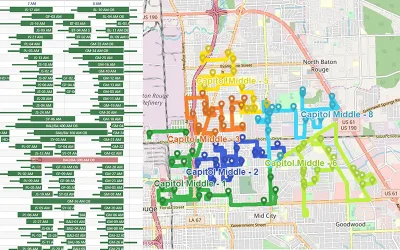
Clipboards in hand, the Prismatic team observed morning bus drop-offs. We found that 44% of the buses were more than half empty at arrival. These observations were corroborated by bus counts from drivers themselves, which showed that 52% of buses were half-empty or worse at arrival. Of the 1,500 regular education bus runs for which the district had driver-reported data, 125 runs were dropping off 10 or less students. That included 4 runs that were each dropping off just 1 student. How much could the district have saved by adjusting their runs so that every bus was at least half full? Maybe $8M per year?
The 2nd answer to why “increased transportation costs” are so often the rock in the road to healthier SSTs has to do with our perceptions of money in general. In short, “millions of dollars” are often less money than you think. Almost none of us has millions in the bank, so when the “M word” starts getting used, we see it as a bigger rock than maybe it is.
In 2019, the AACPS transportation budget was $56.8M, so adding $8M would have been a 14% increase. But that is not the right context. What many overlook is that transportation spending is typically only 4-7% of a school district’s budget. In the context of the overall AACPS budget, that $8M was not even 1% of the total. It was actually less than 1/3 of 1% of the total. If the number needed really is $8M and we work at it, maybe we can find a way to save 1/3 of 1% somewhere else so we can afford healthier SSTs.
So now my advice to everyone is this. If the big roadblock to healthier SSTs is “increased transportation costs,” you should say, “show me the data.” Show me the data and let’s talk about what the data are and what assumptions underlie those data. And then let’s pick that apart because oftentimes, we make erroneous assumptions. Sometimes the erroneous assumption is that healthier SSTs will increase transportation costs. Other times, the erroneous assumption is that we cannot afford healthier SSTs.
How did it turn out in AACPS? In 2022-23, AACPS moved all their SSTs. Elementary schools began at 8:00a, high schools at 8:30a, and middle schools at 9:15a. Did it cost an additional $8M a year? Nope. With a lot of route reworking, those SSTs were achieved without adding a single bus. $8M turned out to actually be $0.